
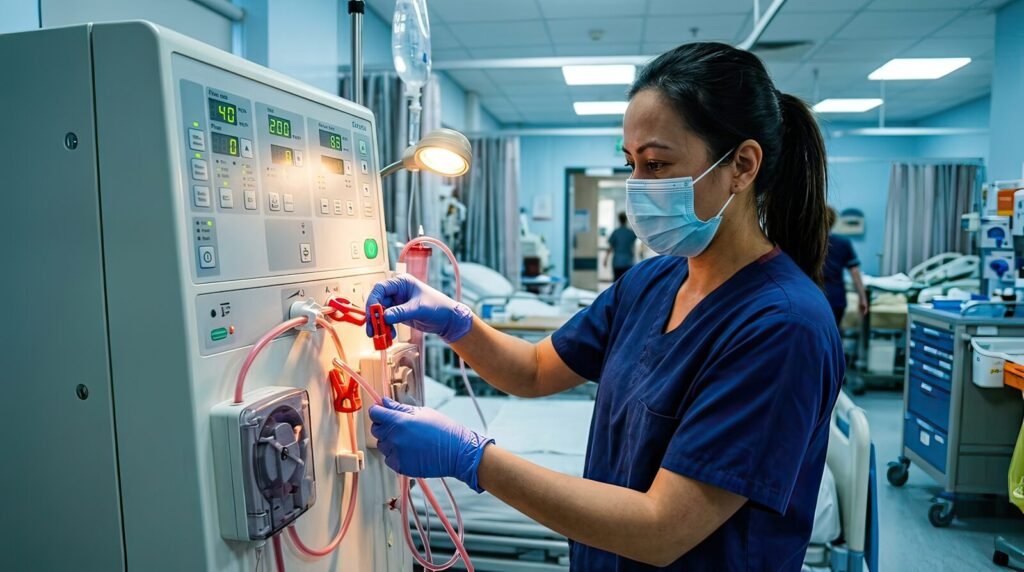
Setting up a dialysis unit
A dialysis unit is a water plant, a set of machines and a trained team that must all work every day. This guide lists what to plan before you order equipment.
- PlanPatients and shifts
- SpaceStations and isolation
- WaterTreatment plant and testing
- MachinesHaemodialysis or HDF
- PeopleTechnicians, nurses, service
What does a hospital need to start a dialysis unit?
A hospital needs enough floor space for each station, a water treatment plant that meets dialysis water standards, haemodialysis machines including one kept for infective cases, trained technicians and nurses, a nephrologist to supervise, and a service partner who can keep the machines and water system running. Plan the water and the service before choosing the machine model.
Why more dialysis capacity is needed
The national dialysis programme estimates about 2.2 lakh new patients with end-stage kidney disease in India every year. Many still receive less treatment than recommended: in a study of 30 centres in west, central and southern India, 53.66% of new patients were on twice-weekly dialysis.
Therapy is also changing. In the CONVINCE trial, 17.3% of patients on high-dose haemodiafiltration died during follow-up compared with 21.9% on high-flux haemodialysis, a hazard ratio of 0.77. Haemodiafiltration needs ultrapure dialysis fluid, which raises the standard your water system must meet.
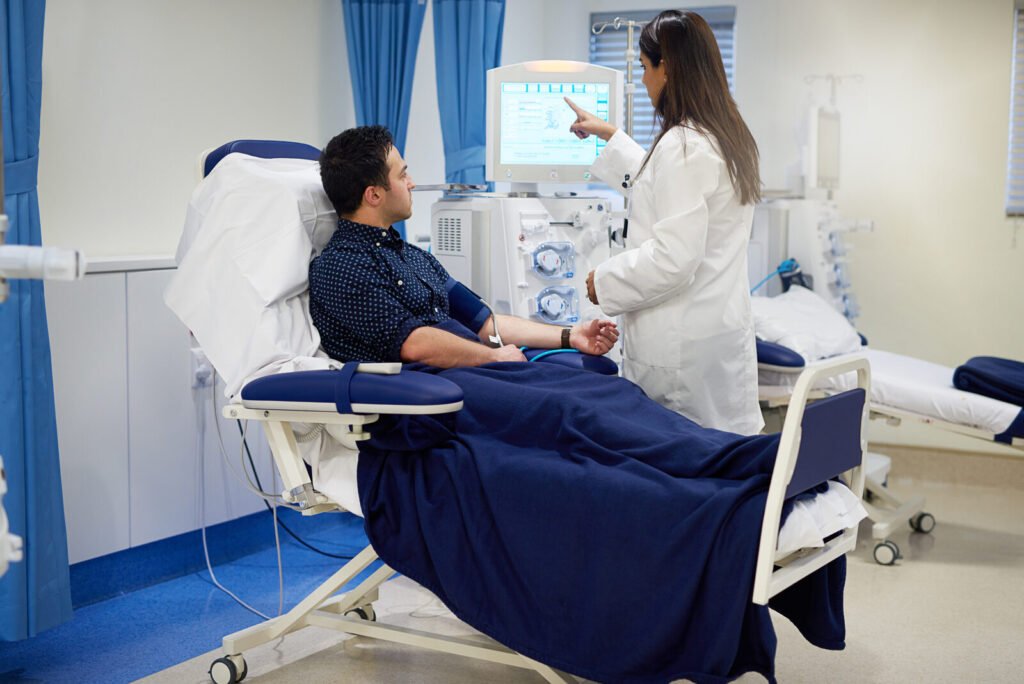
Planning norms and water standards
| Item | Reference value | Source |
|---|---|---|
| Minimum machines | 4, plus one for infective cases | PMNDP guidelines |
| Space per machine | 120 sq ft | PMNDP guidelines |
| Technicians | One for every 3 machines | PMNDP guidelines |
| Dialysis water, bacteria | Below 100 CFU/mL | ISO 23500-3 |
| Dialysis water, endotoxin | Below 0.25 EU/mL | ISO 23500-3 |
| Ultrapure dialysis fluid | Below 0.1 CFU/mL and 0.03 EU/mL | ISO 23500-5 |
Some Indian guidelines quote older, less strict water limits. Agree with your nephrologist which standard the unit will work to.
Planning checklist
Patient numbers
Stations and shifts per day decide everything else.
Water treatment
Plant capacity, loop design and a testing schedule.
Machines
Haemodialysis, or haemodiafiltration if you plan to offer it.
Isolation
A separate machine and area for infective cases.
Power and drainage
Backup power and drains at every station.
ICU needs
Continuous therapy (CRRT) for patients too unstable for standard dialysis.
See the Fresenius 4008S NG, 5008S and multiFiltratePRO, or all nephrology and dialysis systems.
How Milap helps
Planning with you
We look at your site and patient numbers before you order.
Installation and commissioning
Done by Milap engineers.
Training
For technicians and nurses on the machines supplied.
Service
AMC and CMC contracts, with breakdown calls answered during evenings and weekends too.
Sources
Pradhan Mantri National Dialysis Programme and its haemodialysis guidelines.
ISO 23500-3:2024, water for haemodialysis and related therapies.
Blankestijn PJ et al., CONVINCE trial, N Engl J Med 2023.
Konnur AM et al., Indian J Nephrol 2026.
CDC, water use in dialysis.
Frequently asked questions
PMNDP guidelines suggest at least four, plus one for infective cases. Your patient numbers and shifts decide the rest.
PMNDP guidelines use 120 sq ft per machine, plus room for the water plant, storage and staff.
CDC guidance is to test dialysis water for bacteria at least once a month. Indian standard treatment guidelines ask for microbiology and endotoxin tests every 15 days. Follow the standard your unit adopts.
Haemodiafiltration adds convection to remove larger molecules and needs ultrapure dialysis fluid and a machine designed for it.
Yes. Milap engineers install, train and service the Fresenius systems we supply.
Planning a dialysis unit?
Tell us your patient numbers and site and we will help you plan machines and service.