
How to choose a coagulation analyzer
Surgeons, cardiologists and physicians all act on clotting results, often the same day. This guide covers what to check in the analyzer and in the sample.
- MenuPT, APTT, fibrinogen, D-dimer
- MethodClotting, chromogenic, immunoassay
- WorkloadTests per hour
- SampleCitrate tubes filled correctly
- SupportReagents and service
What should a laboratory look for in a coagulation analyzer?
Match the analyzer to the tests your doctors request and the number you run each day. Check that it covers PT with INR, APTT and fibrinogen, and D-dimer if you need it; which detection methods it offers; how many tests it completes in an hour; whether it takes urgent samples without stopping a run; and who supplies reagents and service locally.
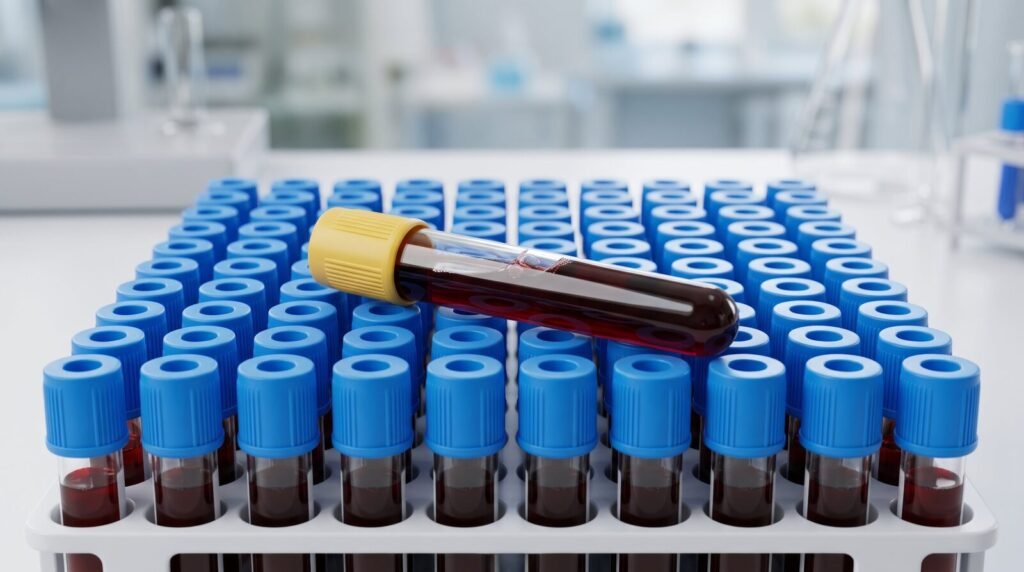
Good results start with the blue-top tube
Coagulation tests are sensitive to how blood is collected. The tube must contain 3.2% citrate with nine parts blood to one part anticoagulant, and tubes less than 90% full should be collected again. In unopened tubes at room temperature, PT is stable for 24 hours but APTT for only 4 hours. Patients with a haematocrit above 55% need the citrate volume adjusted.
Results guide real doses. For patients on warfarin with a mechanical heart valve, guidelines set an INR target of 2.5 (range 2.0 to 3.0) for an aortic valve and 3.0 (range 2.5 to 3.5) for a mitral valve, so a wrong INR leads directly to a wrong dose.
Detection methods compared
| Method | Used for | Notes |
|---|---|---|
| Clotting (optical) | PT, APTT, fibrinogen, factor assays | Detects the clot by a change in light |
| Chromogenic | Antithrombin and similar assays | Measures a colour change |
| Immunoturbidimetric | D-dimer | Measures particles clumping |
The Sysmex CA-600 series runs up to 60 PT tests an hour by scattered-light clotting detection, and the CA-660 model adds chromogenic and immunoassay methods including D-dimer. See all coagulation analyzers.
What to check before you buy
Test menu
Routine tests today, and D-dimer or factor assays if you plan to add them.
Throughput
Tests per hour for a mixed PT, APTT and fibrinogen workload, not PT alone.
Urgent samples
A STAT position so an emergency sample is not kept waiting.
Random access
Different tests on each sample in one run.
Reagent handling
On-board cooling and how long reagents last once opened.
Connectivity
Results sent to the LIS without retyping.
How Milap helps
Site check and demo
We look at your workload and location, and show the system working before you decide.
Installation by our own engineers
Commissioning, checks and handover are done by Milap engineers.
Training for every shift
Application training for the nurses, technicians and doctors who will run samples.
Service after the sale
AMC and CMC contracts, with breakdown calls answered during evenings and weekends too.
Sources
CLSI H21 collection requirements, summarised by CAP Today.
Specimen stability, Washington State Department of Health laboratory bulletin.
ACC/AHA 2020 valvular heart disease guideline, key points.
Sysmex, CA-660 product page.
Frequently asked questions
PT with INR, APTT and fibrinogen for routine work. Add D-dimer if you serve emergency or critical care.
Too little blood leaves too much citrate, which lengthens clotting times and gives a false result.
APTT within 4 hours at room temperature. PT is stable for 24 hours in an unopened tube.
For a few tests a day it can be. For daily routine work an automated analyzer gives more consistent timing and less manual pipetting.
The Sysmex CA-600 series, with installation, training and service.
Need a coagulation analyzer for your laboratory?
Tell us your daily PT, APTT and other tests and we will suggest a model and arrange a demo.