
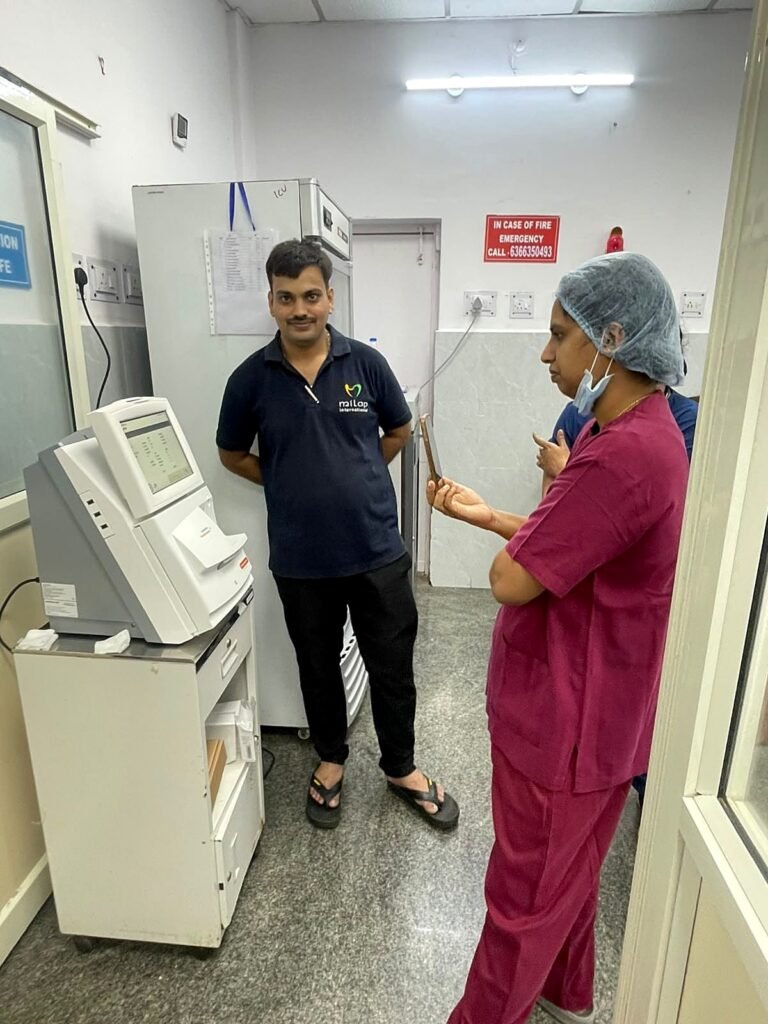
How to choose a blood gas analyzer
A blood gas result is only useful if it reaches the doctor while the patient is still in front of them. This guide sets out what an ICU, emergency department or laboratory should check before buying.
- WhereICU, emergency or laboratory
- WhatTest menu and sample volume
- How fastSample in to result on screen
- RunningCartridge life, QC and connectivity
- AfterLocal service and training
What should a hospital look for in a blood gas analyzer?
Choose a blood gas analyzer by where it will be used and who will run it. Check the test menu, sample volume, time to result, how the cartridge and quality control are managed, whether results reach your LIS or HIS on their own, and who will service it locally. Price per test matters, but only after these are settled.
Why turnaround time matters most
In a randomised emergency department study of 2,323 patients, results came back in a median of 14 minutes with point-of-care testing against 55 minutes from the central laboratory. A decision was made within one hour for 72.8% of patients with bedside testing, compared with 12.5% without it.
The analyzer is only part of that time. Where it stands, who is allowed to run it and how the result reaches the patient record decide the rest.
Seven things to check before you buy
Test menu
Blood gases and pH alone, or electrolytes, glucose, lactate, CO-oximetry and neonatal bilirubin as well.
Sample volume
Small volumes matter for neonates and for patients sampled many times a day.
Time to result
Ask for the time from sample in to result on screen, not the brochure headline.
Cartridge life and waste
How long a cartridge stays on board, and how many tests you lose if workload is low.
Quality control
Automatic QC saves staff time and gives auditors a record.
Connectivity
Results should go to the LIS or HIS without retyping.
Local service
Who answers a breakdown call at night, and how far away they are.
Cartridge systems and handheld systems compared
| Benchtop cartridge system | Handheld test-card system | |
|---|---|---|
| Example | Siemens RAPIDPoint 500e | Siemens epoc |
| Best place | ICU, emergency, laboratory | Bedside, NICU, transport, small units |
| Sample | 100 µL | At least 92 µL |
| Time to result | About 60 seconds | Under 1 minute after sample is added |
| Consumable | Measurement cartridge, on board up to 28 days | Single-use test card stored at room temperature |
| Suits | Steady daily workload | Low or variable workload, several locations |
See the RAPIDPoint 500e, the epoc blood analysis system and all blood gas analyzers we supply.
Questions to ask every supplier
How Milap helps
Site check and demo
We look at your workload and location, and show the system working before you decide.
Installation by our own engineers
Commissioning, checks and handover are done by Milap engineers.
Training for every shift
Application training for nurses, technicians and doctors who will run samples.
Service after the sale
AMC and CMC contracts, with breakdown calls answered during evenings and weekends too.
Sources
Lee EJ et al., Am J Emerg Med 2010, summarised at acutecaretesting.org.
Siemens Healthineers, RAPIDPoint 500e and epoc product pages.
Frequently asked questions
There is no fixed number. A cartridge system suits a steady daily workload because the cartridge has a set life on board. For a few samples a day, single-use test cards usually waste less.
Close to the patient if results drive immediate decisions. Many hospitals place one in the ICU or emergency department and keep the laboratory in charge of quality control.
Yes. ISO 15189:2022 now covers point-of-care testing, so QC records, operator training and oversight by the laboratory are expected.
Yes, after training. Cartridge and test-card systems are designed for trained clinical staff, with the laboratory supervising.
It depends on the model, test menu and expected workload. Send us your daily sample numbers and we will quote for the system and running cost.
Need help choosing a blood gas analyzer?
Tell us your department, daily samples and tests needed, and we will suggest a system and arrange a demo.